
Imagine this: you are fully focused on finishing a critical weld, sweat sliding down your brow, your arm steady as you control the torch.
In this perfect moment—your view suddenly goes pitch black. Not because the welding is over, but because your welding helmet’s auto-darkening function has “quit” due to no power. You have to awkwardly fling off the helmet, endure the blinding arc, and all rhythm and focus are shattered.
This is not science fiction but a real concern for every welder relying on auto-darkening helmets. The helmet’s “power heart”—the electrical system—is often overlooked during purchase, yet it determines your experience and safety at the most critical moment.
Today, let’s clarify whether a solar-powered or battery-powered system is the right choice for modern welding helmets.
Eternal Sunlight: The Appeal and Reality of Solar-Powered Systems
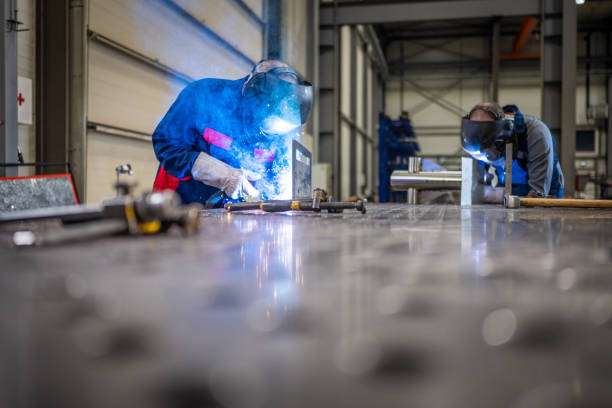
Pick up a welding helmet claiming to be “solar-powered,” and the first feeling is often “hassle-free.” In theory, as long as there is light, it keeps working without worrying about charging or battery replacement.
The core advantages of solar systems are simplicity and eco-friendliness:
- Near-zero maintenance: No need to buy batteries or remember charging; placing the welding helmet in light (even the welding arc itself) replenishes energy. Extremely attractive for welders who dislike tedious chores.
- Environmentally friendly: Reduces disposable battery usage and waste, aligning with sustainable workshop operations.
But behind the “pure solar” myth lies a key condition: light. Its design logic is ideal for well-lit fixed workshops or outdoor work.
However, if you frequently work inside confined tanks, pipelines, or poorly lit night sites, a pure solar helmet may lack sufficient energy. Auto-darkening response could slow or even fail.
Therefore, modern high-standard solar helmets almost always include a backup battery. This battery is trickle-charged by solar power, primarily for extreme low-light conditions or as an energy buffer. Note that this battery is usually sealed and not user-replaceable.
Reliable Foundation: Battery-Powered and Hybrid Systems
Another design philosophy prioritizes “visible, tangible reliability.” These helmets rely on a user-replaceable battery (commonly CR2450 button cells).
The advantages of traditional battery power are absolute control and environmental independence:
- Power visibility: You know when it will run out (usually with a low-battery warning) and can prepare in advance.
- Environment-proof: Whether in a deep ship cabin or midnight underground maintenance, as long as the battery has power, functions are 100% reliable. Replacing a battery takes seconds, instantly “reviving” the helmet.
The ultimate evolution is the solar + replaceable battery hybrid. This is the pinnacle of auto-darkening helmet power design, cleverly combining the advantages of both:
- Solar as primary charger: During most work hours with light, solar panels continuously power the circuit and trickle-charge the replaceable CR2450 battery, greatly extending its lifespan—from months to several years.
- Replaceable battery as ultimate backup: In total darkness, the system seamlessly switches to battery power. When it runs out, you can easily open the compartment and insert a new battery, restoring full reliability immediately.
This design eliminates all power-related anxiety. You enjoy the convenience of zero-maintenance solar while having a manual “lifeline” for extreme conditions.
Scenario Match: Your Workflow Determines Your Choice
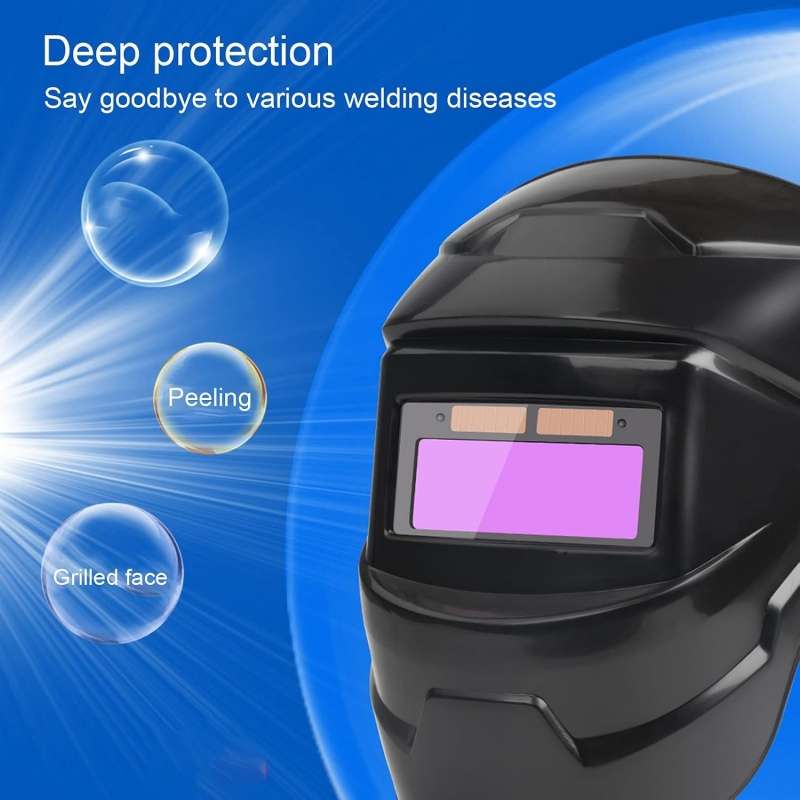
Understanding the principles makes selection clearer. This is not just a tech battle but a precise match of your work habits and environment.
Choose a pure solar/internal battery helmet if:
- You work 95% of the time in well-lit indoor workshops or outdoors with abundant sunlight.
- You pursue extreme simplicity, avoiding any battery-related chores.
- Your welding is continuous, ensuring stable solar input for the welding helmet.
For example, a well-designed true-color solar helmet, with eco-friendly solar power and a large viewing window, is ideal for MIG, TIG, and other standard workshop operations. Its “no charging required” philosophy is its core value.
Consider a hybrid system if:
- Your work environment is variable—today in a bright factory, tomorrow in a dim maintenance pit or inside large equipment.
- You work on pipeline welding, ship repair, or any job requiring entry into confined, dark spaces.
- You suffer from “battery anxiety” and cannot tolerate interruptions caused by uncertain equipment.
- You want welding helmet protection to be absolutely reliable under any condition.
In this case, a helmet with four arc sensors and solar + replaceable CR2450 battery power is a tailored solution. Multi-sensors ensure no-dead-zone auto-darkening, and the hybrid system guarantees protection, whether in the Arctic polar night or on the bottom deck of a ship, without compromise.
Beyond Power: The Chain Effects of Your Choice
| Aspect | Impact |
|---|---|
| Weight & Balance | Solar panel and battery layout affect overall helmet balance. Good design distributes weight evenly, preventing forward tilt and neck fatigue. Trying helmets for balance is crucial. |
| Long-term ownership cost | Pure solar helmets theoretically have the lowest long-term cost. Hybrid helmets require battery replacement every few years, but this is minimal compared to the peace of mind gained. |
| Extreme temperature adaptability | Battery or solar efficiency may drop in extreme heat/cold. Hybrid systems’ dual backup improves reliability in harsh environments. |
FAQ: Your Power Questions Answered
Q: I bought a solar welding helmet. If I leave it unused in the toolbox for two weeks, will it run out of power?
A: It depends on the design. Pure solar with non-replaceable built-in batteries may deplete in total darkness. Hybrid solar + replaceable battery models fare much better. High-quality backup batteries, once fully charged, can support standby and operation for tens or even hundreds of hours without light.
Best practice: place the helmet in light for a few days before long storage. Better yet, if supported, remove replaceable batteries during extended storage for complete safety.
Q: Is replacing the backup battery complicated? Will it affect helmet sealing?
A: Not at all. Modern welding helmets have user-friendly battery compartments. Usually, use a coin or fingernail to open the lid (screw or snap style), replace it with a new CR2450, and close it. The design includes dust-proof sealing; correct operation does not affect helmet integrity.
Keep one or two spare batteries in your workshop toolbox—inexpensive “insurance.”
Choosing a welding helmet power system is like choosing a fuel engine or hybrid for your car. No absolute winner—only the one suited for your journey.
If you pursue a carefree ride on the sunny road, a high-efficiency solar helmet offers pure convenience. But if you know tunnels, valleys, and night roads lie ahead, a hybrid system with a replaceable battery is your reliable companion for all terrains.
It removes the last worry of “running out of power,” letting you focus 100% on achieving the perfect weld. True focus comes from complete trust in your tools.
It’s time to assess your work environment and choose the guardian that never goes blind for your eyes. Explore our recommended hybrid welding helmets