
You clock out after a long day of welding. The project looks great; the beads are solid. But as you drive home, you notice it—that familiar, gritty feeling behind your eyes. A slight headache is brewing at your temples. Maybe you just shrug it off as part of the job. After all, your welding helmet did its primary duty: you didn’t get “flashed.” But what if that lingering fatigue is a sign that your gear is only doing half its job? What if the real danger isn’t the blinding flash you do notice, but the invisible assault you don’t?
For decades, we’ve talked about welding protection in terms of immediate, catastrophic injury. Arc flash. UV burns. Sparks in the eye. These are the acute threats, and a basic hood guards against them. But the modern conversation around a good welding helmet has evolved. It’s no longer just about preventing the accident that sends you to the ER; it’s about preventing the slow, cumulative damage that can affect your quality of life years down the line. Your helmet isn’t just a shield for today; it’s an investment in your ability to keep doing what you love, with clear and healthy eyes, for decades to come.
Beyond the Flash: The Hidden Assault on Your Eyes.
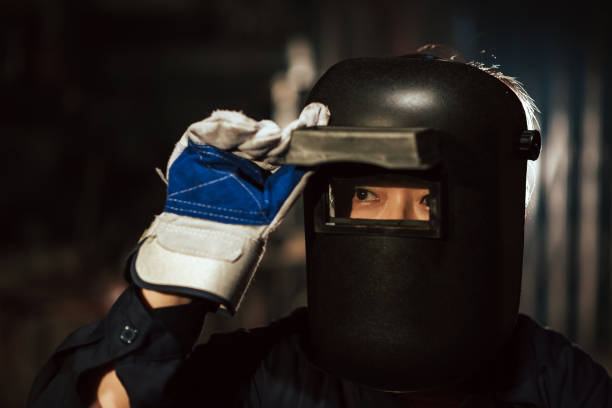
Let’s break down what you’re really facing under the hood. Yes, the intense visible light of the arc is blinding. Yes, ultraviolet (UV) and infrared (IR) radiation are the well-known villains that can burn your cornea and retina. Any certified welding helmet worth its salt blocks 99.9% of these.
But the light spectrum from a welding arc is complex. Nestled within that intense visible light is a high concentration of high-energy blue light. Think of it like this: UV light is the sunburn for your eyes. Blue light is more like the deep, penetrating radiation. While research on long-term effects is ongoing, optometrists and occupational health experts agree: prolonged, direct exposure to intense blue light can contribute to digital eye strain symptoms and may increase the risk of long-term retinal issues.
This is the insidious part. You won’t feel blue light damage happening. There’s no immediate pain signal like a flash burn. The effects are cumulative, subtle, and often chalked up to “just getting older” or having a “long day.” But that persistent eye strain and fatigue? It’s your body’s receipt for a debt you may not know you’re incurring.
The Modern Defense: Not Just Blocking Light, but Filtering It Intelligently
This is where the science of protection gets smart. The best welding helmets today aren’t just dark walls; they’re intelligent filters. They’ve moved from a blunt-force “block everything” approach to a surgical “filter the harmful, allow the useful” strategy.
1. The Blue Light Barrier:
This is the frontline of modern, proactive eye care. Leading-edge helmets now incorporate a specialized blue light-blocking outer lens. This isn’t a gimmick; it’s targeted technology. This lens is engineered to filter out most of the harmful high-energy blue light rays while letting through the less harmful portion of the blue light spectrum. The result is a significant reduction in the overall toxic load on your eyes. By shielding your eyes from harmful blue light, this technology is a direct investment in long-lasting eye comfort and safety, making your helmet ideal for extended welding sessions where cumulative exposure is highest.
2. The Clarity Revolution:
Here’s a counterintuitive truth: a poor-quality dark lens can be just as stressful as no protection at all. If you’re constantly squinting, struggling to distinguish the puddle from the base metal through a distorted, greenish, or blurry view, you’re straining your ocular muscles. This leads to headaches and fatigue that have nothing to do with radiation and everything to do with poor optics.
This is why optical clarity is a health feature, not just a luxury. A helmet with a True Color view and an upgraded 1/1/1/1 optical clarity rating is a game-changer. The “1/1/1/1” is the highest grade—it means minimal distortion, true color representation, and uniform darkness across the entire lens. When your welding helmet offers this level of improved visibility, your eyes aren’t fighting to interpret a shaky, unclear image. They relax. This directly leads to reduced eye strain, allowing you to focus longer with less physical toll. Seeing clearly isn’t just about making better welds; it’s about preserving your vision’s comfort.
3. The Comfort Connection:
Never underestimate how physical strain manifests as overall fatigue. A heavy, ill-fitting helmet that torques your neck and requires constant adjustment is draining your energy reserves. That neck and shoulder tension can contribute to tension headaches that compound eye strain.
A modern helmet designed for long welding sessions tackles this holistically. A lightweight, adjustable fit achieved through pivoting headgear and breathable padding does more than feel nice. By actively reducing neck strain, it removes a major source of whole-body fatigue. When your body is comfortable, your eyes and mind are free to focus solely on the weld, not on the pain in your shoulders.
A Helmet Built for the Long Haul: The Pro Blue-Light Example
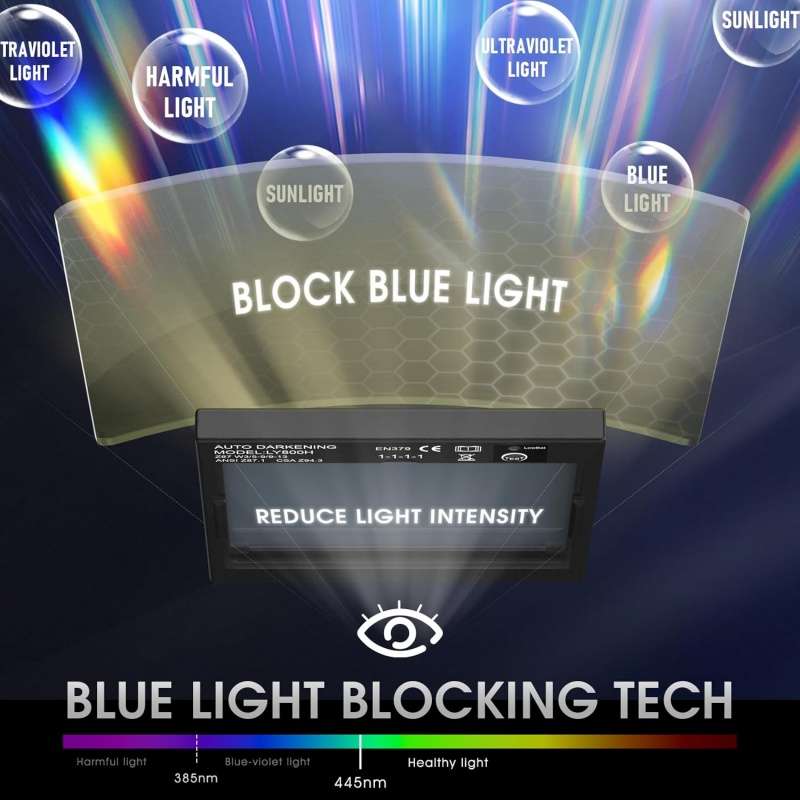
When you look for a welding helmet that embodies this comprehensive, health-first philosophy, the specs tell a clear story. Take the Pro Blue-Light Auto-Darkening Welding Helmet. It reads like a prescription for sustainable craftsmanship.
It starts with its core defense: the cutting-edge blue light-blocking outer lens. This isn’t an afterthought; it’s a foundational layer of its protection. It then pairs this with the visual clarity your eyes crave: a generous 3.93″X3.66″ large view and that top-tier 1/1/1/1 optical clarity for a truly relaxed, accurate sight picture.
But it doesn’t stop at the lens. It understands that reliability is part of safety. Its solar panel technology and battery system ensure a long service life, so you’re never caught with a dead filter. The four arc sensors provide fail-safe detection, and the wide shade range means you’re properly protected whether you’re doing delicate TIG or heavy grinding. Finally, it’s all built into a reinforced PP shell for exceptional durability and wrapped in that comfortable, adjustable headgear. This is what a top welding helmet looks like when it’s designed not just for the weld, but for the welder.
Frequently Asked Questions (FAQ)
Q: Is blue light really that big of a deal? My old helmet never had this feature.
A: Our understanding of occupational health evolves. We now know UV/IR are critical to block, and we’ve done that for years. Blue light filtration is the next logical step in proactive eye safety based on the latest research. While your old helmet protected you from immediate burns, a blue-light filtering model adds a layer of defense against longer-term, cumulative strain. It’s like the difference between sunscreen that only prevents sunburn and one that also prevents premature aging.
Q: Is a “1/1/1/1” optical rating worth the extra cost?
A: Absolutely, if you value comfort and precision. Think of it as the difference between watching a movie on an old, blurry tube TV versus a modern 4K screen. The high-definition clarity drastically reduces the effort your eyes need to expend. For hobbyists, it makes welding more enjoyable. For professionals, it’s a direct tool to combat daily fatigue and maintain peak visual acuity throughout a shift. It’s a feature you feel in your well-being at the end of the day.
Q: How does comfort relate to eye health?
A: More than you might think. Physical discomfort—like neck strain from a heavy, unbalanced helmet—causes tension. This tension often manifests in the head and face, leading to tension headaches and making your eyes feel tired and strained. A comfortable helmet removes this secondary source of fatigue, allowing your visual system to work without extra stress.
The True Measure of Protection
Choosing your next welding helmet is a decision that echoes far beyond your current project. It’s a choice between reactive safety (preventing the bad day) and proactive health (preserving your good days). It’s about selecting a partner that guards you not just from the dramatic spark, but from the silent, slow drain on your most vital tools: your vision and your vitality.
Don’t just buy a shield. Invest in a guardian. Look for the helmet that filters the invisible threats, offers crystal clarity to ease your focus, and cradles your comfort for the long run. Your future self—the one who still loves to create, weld, and see the world in sharp detail—will thank you for it.
Upgrade to a smarter welding helmet today and protect your eyes for a lifetime of safer welding.