
Let’s be clear: not all welding is created equal. If you’re a MIG or stick welder throwing down heavy beads on structural steel, your needs are about power, penetration, and durability. But if you’re a TIG welder—fusing razor-thin stainless, meticulously feeding filler rod into a puddle the size of a pea, or crafting artistic sculptures—you’re playing a completely different game. It’s a game of millimeters, of subtle visual feedback, and of almost surgical precision. And in that game, your standard-issue welding helmet is often your biggest handicap.
Think about it. You’re hunched over a joint, trying to see the faint, clean arc of your tungsten electrode. You need to watch the metal just barely liquefy to see the exact moment to dip your filler wire. But through your hood, everything is a dull, greenish blur. The arc is hard to distinguish from the background, the puddle lacks definition, and you’re squinting so hard you get a headache after twenty minutes. You finish the weld, lift your shield, and hope it looks as good as it needed to be. This isn’t welding; it’s educated guesswork.
For TIG work, your welding helmet isn’t just a piece of safety gear. It’s your microscope, your spotlight, and your steady hand all in one. Choosing the wrong one doesn’t just make the job harder; it caps your skill level before you even strike an arc. Let’s break down why TIG demands a specialist’s approach to eye protection and how to find a hood that unlocks your true potential.
Why TIG Turns Your Helmet into a Critical Tool
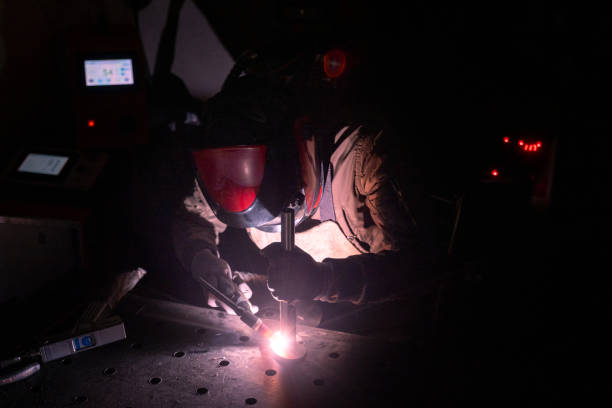
The challenges of TIG welding are unique in the metalworking world:
- The Faint Arc: Compared to the roaring, spark-filled inferno of MIG or stick, a TIG arc (especially at low amperages on thin material) is a precise, hissing flame. It’s less bright and can be easily washed out by shop lighting or, paradoxically, missed by a helmet sensor that’s not sensitive enough.
- The Need for Visual Clarity: Every detail matters. You must see the sharp point of your tungsten, the precise edge of the base metal, the formation of the puddle, and the end of your filler rod—all simultaneously and without distortion. A blurry or color-shifted view means missed cues, leading to cold laps, undercuts, or just an ugly weld.
- The Marathon, Not a Sprint: TIG is slow, deliberate work. You might be in position, helmet down, for an hour on a single critical pass. Comfort and reduced eye strain aren’t luxuries; they’re prerequisites for maintaining the steady focus and hand control the process demands.
The Anatomy of a TIG-Optimized Welding Helmet
So, what should you look for when your welding helmet needs to be a precision instrument? Forget “heavy duty” and think “high definition.”
1. Optical Clarity is King (or Queen). This is the non-negotiable starting point. You need the clearest, most true-to-life view possible. The industry measures this with an optical class rating: 1/1/1/1. This is the highest grade, representing minimal angular distortion, uniform shade, and consistent luminous transmission. In human terms? It means what you see is sharp, stable, and accurate. A helmet with upgraded 1/1/1/1 optical clarity and a True Color view removes the guesswork. The puddle looks liquid, not like a blurry bright spot. You can judge depth and wetting action accurately. This directly translates to improved visibility and reduced eye strain, letting you focus on technique, not on deciphering a poor image.
2. Sensor Sensitivity & Speed. A helmet that’s slow to darken or fails to detect a low-amp TIG arc is dangerous and frustrating. Look for helmets that advertise adjustable sensitivity controls. This allows you to crank up the sensor’s responsiveness so it triggers reliably on that faint arc. Furthermore, 4 arc sensors are vastly superior to 2 for TIG work. They provide redundant detection from multiple angles, ensuring the lens darkens even if your torch hand or workpiece shadows one sensor. Pair this with ultra-fast switching (1/30000 sec) speed, and you have a system that protects you instantly without that disorienting flash.
3. The Wide-Shade Range for Versatility. A great TIG helmet doesn’t just do low-amp work. You might start the day on delicate 40-amp aluminum, then switch to a 150-amp stainless pipe weld. A wide shade range like 3/5-9/9-13 is perfect. The 3/5-9 range is your TIG sweet spot (typically shades 8-11), while the 9-13 range handles higher amps or even grinding. This multi-application capability means one welder mask can handle your entire TIG and post-weld cleanup workflow.
4. Comfort for the Long Hold. When you’re locked in a position for a long bead, neck fatigue is the enemy of a steady hand. A lightweight helmet with pivoting headgear is essential. The pivoting action allows you to lift the hood smoothly with a nudge of your head, not a full-neck throw, making it easy to check your work without breaking your entire posture. Breathable padding and an adjustable fit ensure the helmet feels secure but never constricting, reducing neck strain during long welding sessions.
From Fuzzy to Focused: A Helmet That Gets TIG
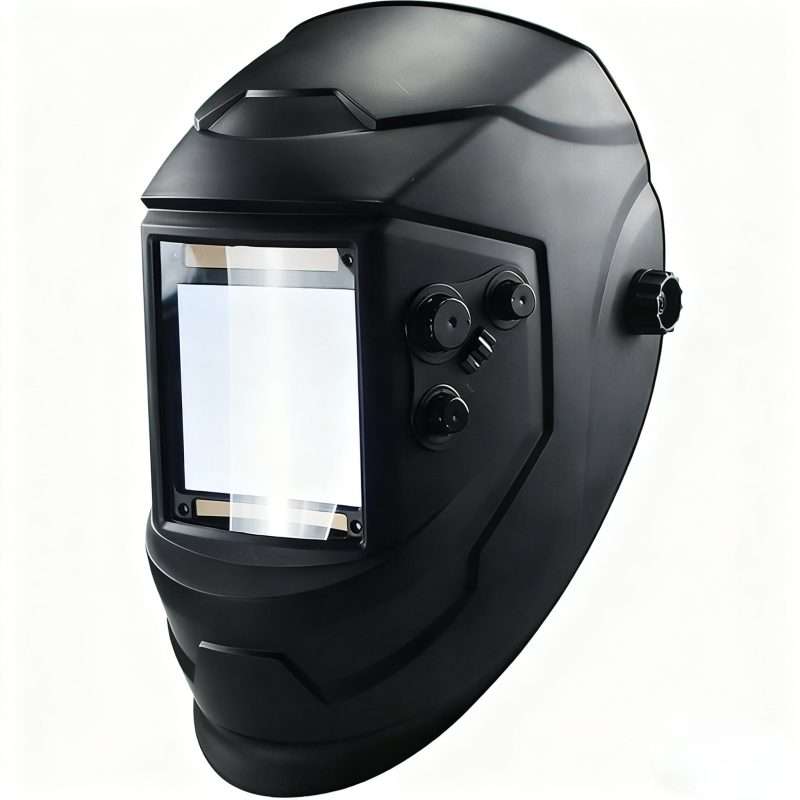
When you piece these requirements together, you get a picture of a specialized tool. A helmet like the Pro Blue-Light Auto-Darkening Welding Helmet is engineered with these precise demands in mind.
It starts with the visual foundation: a 3.93″X3.66″ large view with that critical 1/1/1/1 optical clarity and True Color technology. This is your window to the weld zone. Its 4 arc sensors and adjustable sensitivity and delay controls give you the dials to fine-tune performance for any amp range, from whisper-quiet to roaring. The wide shade range (3/5-9/9-13) covers all your bases.
It even adds a thoughtful layer of long-term protection with its blue light blocking outer lens, shielding your eyes from harmful blue light during those extended welding sessions. And to ensure it’s always ready, it uses efficient solar panel technology with a replaceable battery for a long service life. Wrapped in a reinforced PP shell for durability and the comfort-focused headgear, it represents what a top welding helmet for TIG should be: a clear, responsive, and comfortable partner in precision.
Frequently Asked Questions (FAQ)
Q: I already have an auto-darkening helmet for MIG. Why do I need a different one for TIG?
A: You can use a general-purpose helmet for TIG, but it’s like using a butter knife for surgery. It might work, but poorly. TIG-specific features like high optical clarity (1/1/1/1), adjustable sensitivity for low amps, and multiple sensors are designed to solve the specific visual and detection challenges of TIG. The difference in control, comfort, and weld quality is often dramatic.
Q: Is the “blue light filtering” feature really important for TIG?
A: It’s a significant benefit, especially for TIG welders. TIG arcs produce a very bright, concentrated light with a high blue light component. Because you’re often closer to the work and welding for longer, continuous periods on a single piece, your cumulative exposure is high. The blue light blocking lens filters out most of the harmful high-energy blue light rays, which can reduce long-term eye strain and fatigue, making those long, detail-oriented sessions more sustainable.
Q: What’s more important for TIG: a larger view or a higher optical class?
A: Optical class is the priority, but you ideally want both. A 1/1/1/1 optical class ensures that whatever you see—whether through a standard or large lens—is accurate and strain-free. A larger view (like a 3.93″ x 3.66″ area) then takes that superior clarity and gives you more of it, providing better peripheral vision of your workpiece and filler rod. The combination is what creates that immersive, controlled environment perfect for TIG.
Elevate Your Craft, Don’t Just Protect It
Choosing your welding helmet for TIG work is one of the most impactful decisions you can make for your craft. It’s the difference between struggling against your equipment and having your equipment elevate your skill. Don’t let a generic shield be the limiting factor in your precision work.
Invest in a helmet that gives you a crystal-clear view, reacts with lightning speed to your arc, and cradles your comfort through the longest projects. Find the welding helmet that doesn’t just protect your eyes but becomes the clear lens through which your best work is possible. Your welds—and your enjoyment of the process—will reach a new level of clarity.
Upgrade to a TIG welding helmet that enhances precision and optical clarity, supporting long sessions and expert-level metalwork.
You’re spot on about how TIG welding is all about finesse. I’ve definitely noticed the difference when using a helmet with better clarity—it makes such a huge impact on how well you can control the weld puddle and keep everything consistent.
Totally agree! Having a clear welding helmet really makes it easier to see the puddle and just makes everything feel smoother to handle.