
Every time you pull the trigger on a welding gun, that “instant blackout” behind your helmet is far more than a simple light-to-dark switch. In microseconds, a precise electronic defense battle unfolds—it’s your eyes’ invisible bodyguard at work. Today, we won’t talk brands; we’ll dissect the principle.
Understanding how the auto-darkening filter (ADF) in your welding helmet’s “brain” and “nerves” operates will make your next investment decision wiser.
From Arc to Signal: Sensors as Your “Peripheral Sentinels”
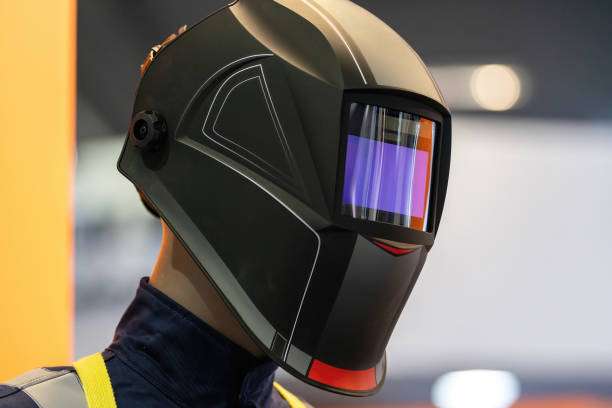
Imagine a few tireless guards at the front of your helmet. In an auto-darkening welding helmet, these guards are arc sensors. Typically 2 to 4 photosensitive elements, they are distributed around the lens frame, continuously monitoring ambient light intensity, and are especially sensitive to high-intensity UV and IR radiation from welding arcs.
The key is multi-sensor layout. Why multiple sensors? During welding, your head posture constantly changes—side welding, tilting, etc. A single sensor can easily be blocked (by your arm, workpiece, or helmet structure), leading to “blind spots” and failure to darken. Multiple sensors form a redundant monitoring network, ensuring at least one sees the arc, greatly enhancing trigger reliability. High-performance helmets may feature 4 sensors for near-complete coverage.
Decision Center: Microsecond Computation in the Control Unit
When a sensor detects the arc’s intense light, it instantly transmits an electrical signal to the helmet’s micro control unit—the “brain” where key decisions occur.
The brain performs two functions:
- Determine whether it’s a real arc requiring a reaction, rather than a random glare or light reflection. This is the sensitivity adjustment. In bright workshops with reflective metals, you may lower sensitivity to avoid false triggers; in dim environments, increase it to ensure reliable activation.
- Decide the degree of darkening (shade level) and speed. Different welding processes (e.g., low-amp TIG or high-spatter MIG) require different darkness. A wide shade range (e.g., 3/5-9 to 9-13) allows the same helmet to handle tasks from fine work to heavy cutting.
“Blink” Executor: How the LCD Shutter Darkens Instantly
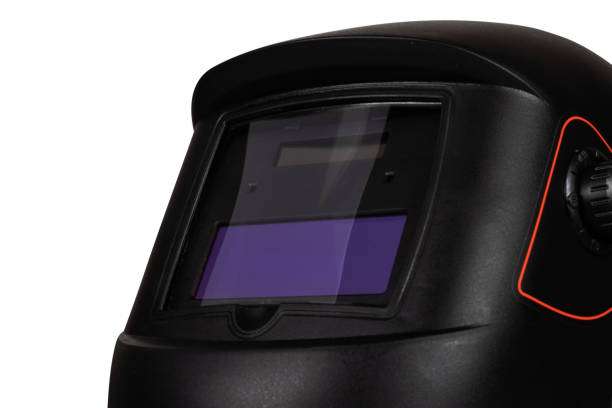
Once commanded, the liquid crystal shutter (LC shutter) executes. Located between inner and outer protective lenses, it contains a thin layer of special liquid crystal. In the unpowered state, molecules are orderly, allowing light to pass (“bright state”). When energized, the electric field instantly disrupts molecular alignment, scattering incoming light, switching to a “dark state” in fractions of a millisecond.
This switching speed is a critical specification. Response times of 1/30,000 or 1/25,000 seconds ensure that harmful light is blocked before reaching your retina—several orders faster than the human blink reflex (~0.1 seconds). This speed eliminates the risk of “arc eye.”
Beyond Darkness: Delay, Field of View, and Optical Clarity
The helmet’s “brain” also controls delay time. After welding stops, the lens remains dark for a set period. Adjustable delay filters residual bright red light from the weld, protecting your eyes while allowing inspection without lifting the helmet, enhancing efficiency.
This protection experience is ultimately presented through the viewing window. A large viewport (e.g., 3.93×3.66 inches) provides a broad field of vision, improving awareness of the workpiece and surroundings, enhancing operational safety. Optical grade matters: 1/1/1/1 precision ensures crystal-clear, distortion-free, true-color images from center to edge, reducing visual fatigue during extended focus and allowing precise welding.
Power Source: Reliable and Enduring Support
Such precise electronics require stable power. Modern welding helmets often employ a dual system: solar panels as main or auxiliary power, continuously operating or charging internal batteries in ambient light, alongside replaceable backup batteries (e.g., CR2450). This ensures uninterrupted power even in complete darkness, achieving truly eco-friendly, long-lasting operation.
Frequently Asked Questions (FAQ)
Q: Do auto-darkening lenses have a lifespan? How often should they be replaced? Can they be repaired?
A: Yes, auto-darkening units have a lifespan, usually measured in “switch cycles” or years of use. High-quality units can handle hundreds of thousands of cycles. Signs of end-of-life include slower darkening, uneven shading, or failure to return to a bright state. Typically, the module is replaced as a whole; users cannot repair the internal LCD. Choosing reliable designs with quality materials and avoiding extreme temperatures, humidity, or physical impact extends lifespan.
Q: If I work mainly in dim workshops or outdoors at night, will the auto-darkening function fail?
A: No. Auto-darkening relies on detecting the arc’s high-intensity radiation, not absolute ambient light. Even in darkness, the arc’s instant bright light is sufficient to trigger the darkening. In fact, in dark environments, the helmet may be even more appreciated, providing a clear, ambient-independent window to observe the workpiece.
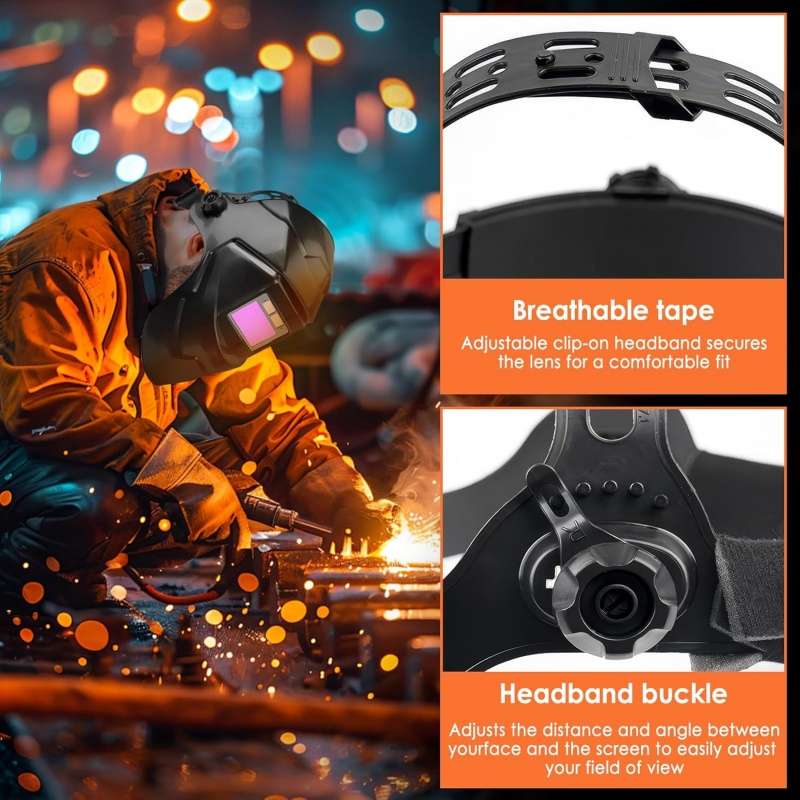
Understanding these microsecond-precise protections reveals a welding helmet’s true value. It is not merely a mask but a complex safety system integrating optics, electronics, materials, and ergonomics.
When evaluating a helmet, look beyond appearance to its “neural network” (sensor count), the “brain” intelligence (adjustability, shade range), “reaction” speed (response time), and the “world” it presents (viewport size and optical grade).
Choosing a technically advanced welding helmet entrusts your visual health to a smart partner that maintains absolute focus and ultra-fast reaction with every arc. This investment safeguards your most irreplaceable asset in your career—your eyes. It’s time to arm yourself with knowledge and make smarter safety gear choices.